Pulpí Geode, the largest in Europe

The Pulpí geode, also known as Pilar de Jaravía geode, is located in the Aguilón mountain range, in the Pilar de Jaravía district, specifically in the municipality of Pulpí, Almería. It is a giant geode that is covered by large crystals of selenite, a transparent variety of gypsum. It is located between the third and fourth level of exploitation of the so-called Mina Rica.

This enormous geode was discovered in December 1999 by the Mineralogist Group of Madrid. The Pulpí geode is the second largest in the world and the largest in Europe. In addition, it is the only one in the world where visits are allowed without special equipment.
A geode of enormous dimensions
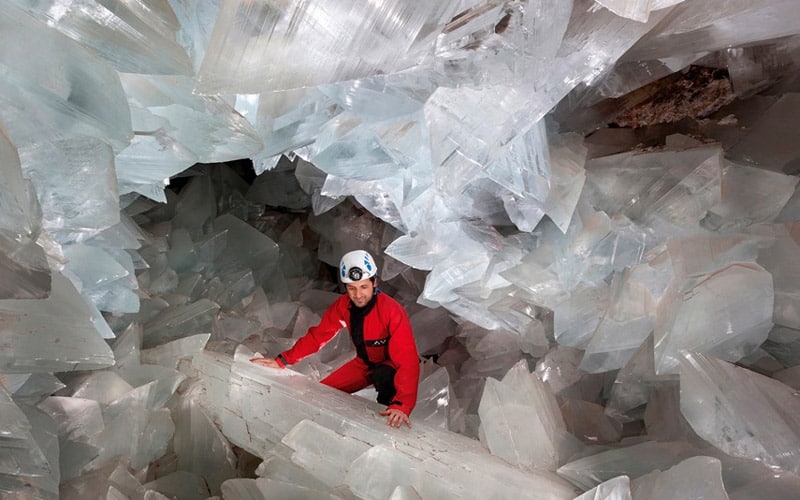
Pulpí geode occupies a cavity eight meters long and almost two meters high that is covered by large gypsum crystals at a depth of 60 meters. Its state of conservation is excellent, being a unique element worldwide due to its enormous dimensions and the transparency of its crystals, some of which reach 2 meters in length. 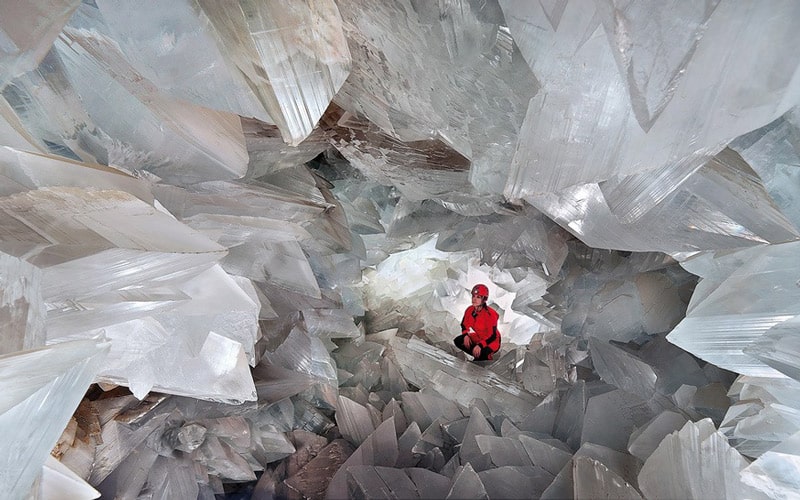
As for its origin, two phases must be highlighted: the formation of the hole and, on the other hand, the mineral deposit inside it. The hole in the rock was created by the karstification of the rocks that make up the Sierra del Aguilón, together with volcanic hydrothermal springs. Karstification is a phenomenon that occurs in the soil due to the presence of gypsum and limestone, so there may be a dissolution effect. If this occurs, cavities appear that may or may not be filled in. On the other hand, the explanations about the mineral deposit in the geode are believed to be the result of a mixed karstic-hydrothermal model.
The crystals are a combination of calcium sulphate, that is, gypsum. The process that gave rise to these extraordinary crystals was carried out over thousands of years, in which the fractured rock was gradually filled with hot water of volcanic origin. Over time, geologically speaking, the water cooled and the gases evaporated. This is when the water and the calcium sulphate began to crystallise.
An old mine
On the slopes of the Sierra del Aguilón, in the depths of the earth, you can still see the facilities of the mining operations that were developed from the mid-19th to the end of the 20th century. The Pilar de Jaravía mine was called "Quien tal pensara", also called the Mina Rica. After decades in operation, with the arrival of the Civil War it fell into disuse.
In this way, the miners never found the geode, because if they had, they might have razed it to access other materials, as it already happened with another large one whose remains can be seen in the third level of the mine.
Then, 20 years later, the project to reopen the Mina Rica begins, so that everyone can marvel at the legacy of the Pulpí miners.
Visit to the Pulpí geode


Upon reaching the second level of this five-level mine, one descends a 15-meter spiral staircase. This leads to a wall where the pocket is located, between levels 3 and 4. To see it you have to lean out of a small hole and look at the pocket. It is very easy to be amazed by the large, translucent crystals.