
Things to do in Cartagena
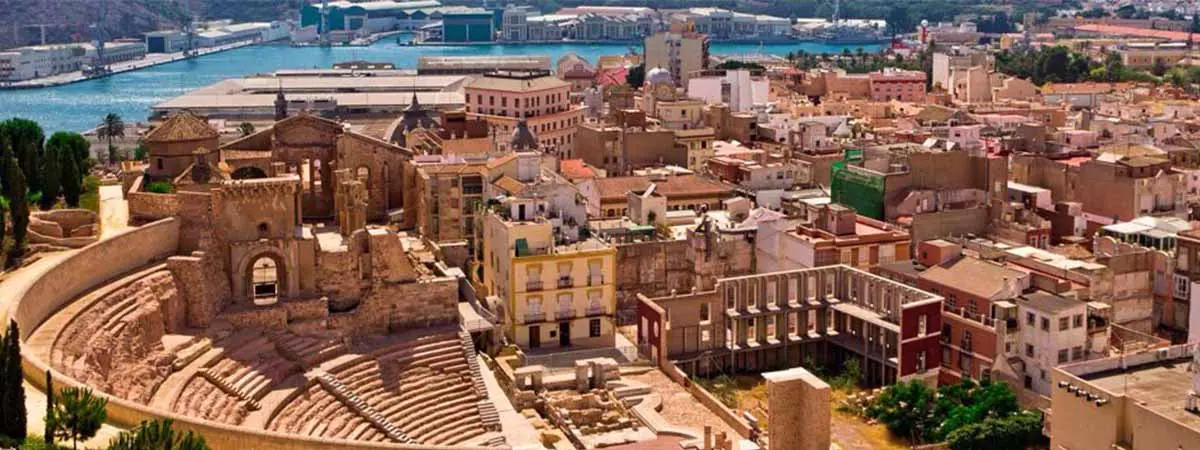
Cartagena, the port of all cultures
Cartagena is a city in Murcia with an extraordinary bay where different cultures settled more than two millennia ago. This has meant that it has inherited a vast historical and cultural legacy. In recent years it has undergone a major transformation, becoming a major tourist destination.
Cartagena has important monumental attractions and a wide variety of beaches and active tourism all year round. Are you ready to see everything there is to visit in Cartagena, Murcia?
Plan your stay in Cartagena
There is a lot to see in Cartagena, a city with multiple attractions about the Carthaginian and Roman civilizations. Also spaces of military and underwater character, its cathedral and others. A getaway to Cartagena implies two full days of visits and walks.Besides what there is to see in Cartagena, you can enjoy the surrounding beaches and trips. Some of the places to visit are La Unión, Calblanque Natural Park and La Manga del Mar Menor. You also find places where you can practice active tourism all year round.Do you want to visit this place?
History of Cartagena
Throughout Cartagena's history, several civilizations, cultures and religions have passed by. They took advantage of its status as one of the best natural harbours in the Mediterranean.Carthaginians
The Carthaginian general Hasdrubal founded, in 227 B.C., the city of Qart Hadasht on a previous Iberian or Tartessian settlement called Mastia.
Romans
The city was conquered eighteen years later by the Roman general Publius Cornelius Scipio. He named it Carthago Nova. Romans gave it the title of colony in 44 A.D., making it the capital of the province.
During the 2nd and 3rd centuries it was plunged into a deep crisis from which it would not emerge until the Byzantine period in the 6th century. In 461, the Roman Emperor Majorian gathered a fleet for the invasion of the African empire of the Vandals. Finally, the Vandals attacked the city by surprise and defeated it in the Battle of Cartagena.The city was conquered in 555 by the troops of Emperor Justinian and was under Byzantine rule.
In 622, it was destroyed by the Visigoths of Suintila. With the capitulation of the Kurah of Tudmir, in 734, the town passed into the hands of the Arabs. They gave it the name of Qartayannat al-Halfa. Five centuries later, in 1245, it was conquered by Prince Alfonso of Castile, the future Alfonso X the Wise.
Habsburgs
During the Modern Age, Cartagena was under the rule of the Habsburgs. Together with Málaga, it was the only Mediterranean port authorized to trade with the Indies.
Later, in 1726 and at the hands of King Charles III, the city was chosen as the capital of the Maritime Department of the Mediterranean. Impressive fortifications and an arsenal were built for the Navy. As a result of this economic boost, its population increased fivefold in a few years.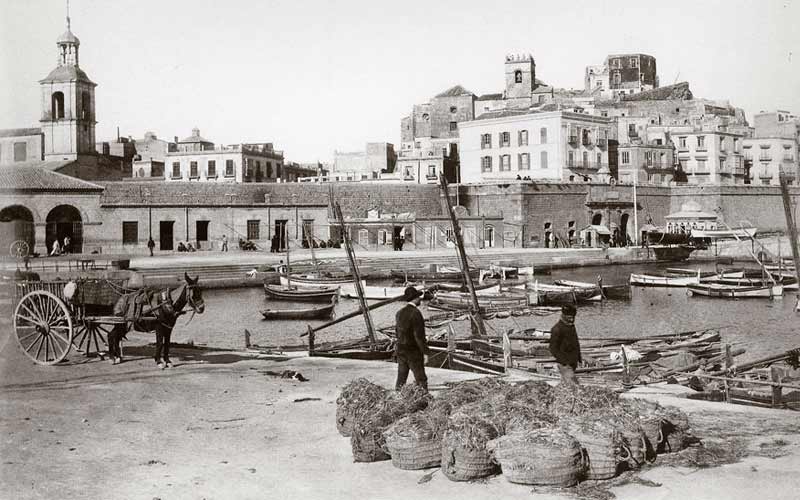
Cantonalism
On July 12, 1873, the young medical student Manuel Cárceles proclaimed the canton of Cartagena. In fact, he got the sailors of the garrison to join his proposal for secession from Spain. The troops of the Government of Madrid bombed the city until its surrender on January 11, 1874.
During the last third of the 19th century, the mining mountains of Cartagena-La Unión facilitated the economic development of the city. Many important modernist and eclectic buildings were built and can still be seen.
Spanish Civil War
During the Civil War, Cartagena was a base of operations for the Republican fleet and was heavily bombed by Franco's troops.
This naval base witnessed one of the most spectacular strikes of the final stage of the war. During the night of March 4, 1939, some Republican soldiers sympathetic to Franco's regime rose up against their superiors. They took the fortifications of Cartagena and aimed their cannons at the army of the Republic. The people took refuge in the port of Bizerta.
At present
Nowadays, Cartagena continues being one of the most important cities of Murcia. It is oriented towards the service sector, mainly trade and tourism. This is due to its location in one of the most privileged areas of Murcia's Costa Cálida.
What to See in Cartagena
To know everything there is to see in Cartagena is to immerse yourself in a sea of cultures. Civilizations have left their mark on the rich heritage that embellishes the old town. In the city you can find everything from Roman to Baroque, Neoclassical, Eclectic and Modernist works. There are also examples of contemporary art by artists such as Rafael Moneo in the Museum of the Roman Theatre.Cartagena's Port
The Carthaginian port has been the element that has marked the history of the city since its beginnings. It is an ideal place to start our visit of the places to see in Cartagena. The port has recently been renovated according to a modern urban plan. It is an ideal place to take a walk and admire the beautiful bay, enclosed between high mountains.
In the area of the marina you will find one of the most appreciated and significant elements of Cartagena: the first submarine of the Carthaginian Isaac Peral. Launched in 1888, it is the prototype of the modern submarine.
At the dock you can take a tourist boat that will take you through the waters around the Mediterranean, a different perspective from which to see Cartagena.
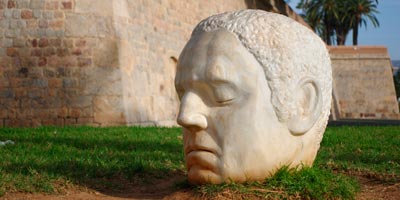
Also to be seen in Cartagena is the Muralla del Mar, or Wall of the Sea, or of Charles III. It was built when the city became the capital of the Maritime Department of the Mediterranean in the 18th century. If we head west bordering it, we will reach the Memorial to the Heroes of Cavite (1923). This is a very dramatic sculpture set.
Buildings and Museums
Another place to see in Cartagena is the Town Hall Square. This large space is dominated by the Palacio Consistorial, one of the main modernist buildings. It was built by Tomás Rico at the beginning of the 20th century. It is a building with a triangular floor plan and a white marble façade, with the zinc domes standing out on the roof. In addition, it is decorated with the emblems of the city. The imperial stairs, the plenary room and the mayor's office are important.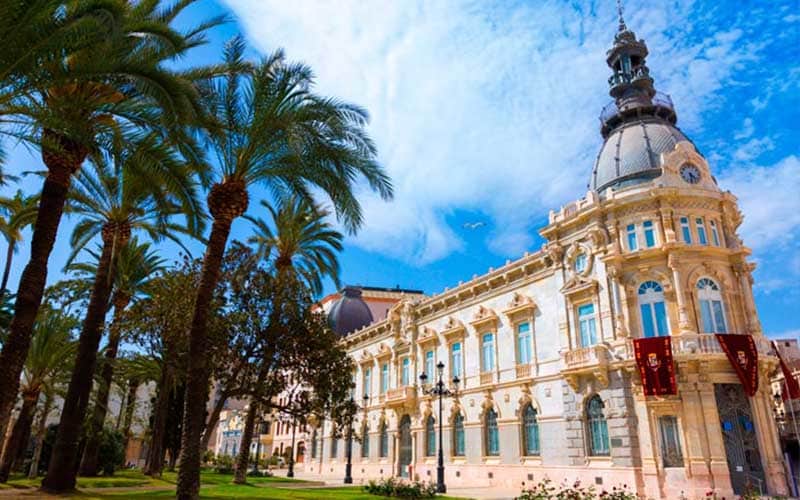
In addition to the museum, the building joins the site of the Theatre, one of the largest in Spain, from the end of the first century AD. It was discovered in 1988. Both represent the most visited monument and museum space in the region of Murcia and the most special to see in Cartagena.
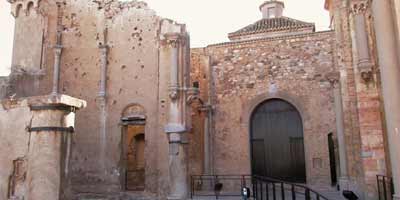
On the right side of the theatre are the ruins of the Cathedral of Santa María, a building from the end of the 13th century. It was destroyed during the Spanish Civil War. Behind the stage are the remains of the Byzantine Wall (which has actually turned out to be a wall from Roman times). It is made up of a straight canvas and a semicircular tower made of sandstone blocks.
Nearby there is also a Roman dwelling with decorated floors. Other remains of the Wall, from the Punic period, can be found near Basterreche Square. There is also the Interpretation Centre of its site, which dates from the 3rd century BC.
A walk through its streets
From the Plaza del Ayuntamiento, we can enter the street with most character in Cartagena, the pedestrian Calle Mayor. There are many modernist facades. Among them, the Casa Cervantes, designed by the architect Víctor Beltrí, stands out. It has its viewpoints, modernist ironwork and a pediment decorated with allegories of trade, mining and industry.
Next to the Calle Mayor is the Casino, which although it was originally built in the 18th century, was renovated in 1897 by Beltrí. With modernist taste, he added bas-reliefs and artistic wrought-iron balconies to the façade.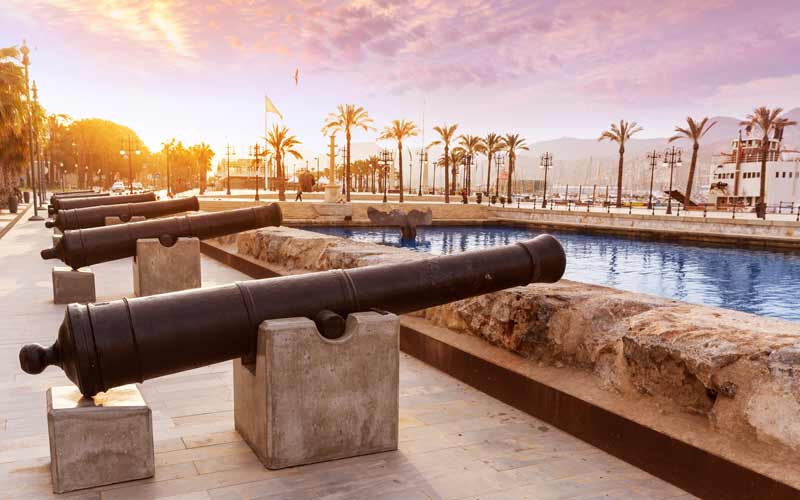
Passing through the gardens of the Plaza de San Francisco, we reach the Augusteum, in Calle Caballero. It consists of a set of remains from the old forum formed by two Roman buildings from 1st and 2nd centuries. There, tools, coins and other elements from Augustus age are exposed.
Nearby there is also the Casa de la Fortuna (1st century B.C.), a must see in Cartagena. This is another Roman building to see in Cartagena, with decoration of mosaics and wall paintings of great chromatism.
Taking Gisbert Street we will arrive at the Roman amphitheatre. If you take the elevator you will reach Torres Park and the remains of the Concepcion Castle. This was built under Arab rule and rebuilt in the time of Henry III of Castile (14th century). The Torre del Homenaje (Homage Tower) is still preserved from the castle and is currently being refurbished as the Centre for the Interpretation of the History of Cartagena.
As for the Amphitheatre (1st century BC), whose remains can be seen from the lift, it must have been of great dimensions. From its construction, which would complete the recreational offer of the Roman Cartagho Nova, only a large canvas of the foundation of the outer wall and some radial walls are preserved.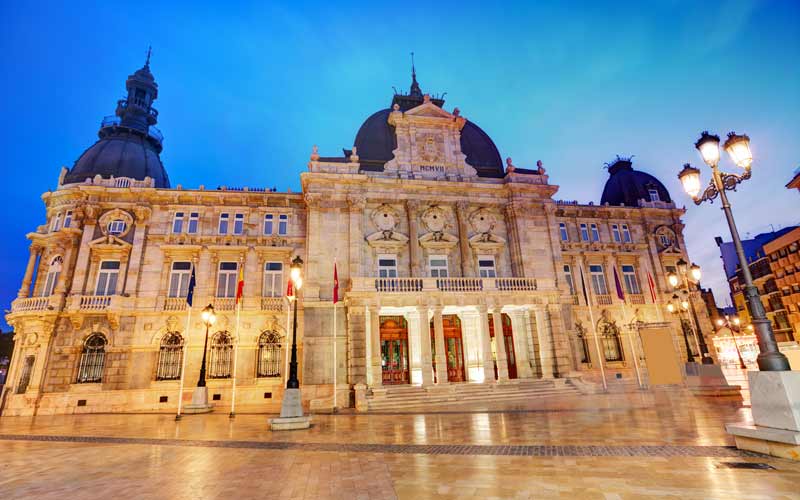
In relation to the defensive architecture, although a little further away from the historical centre, the castles, forts and batteries are impressive. The Batería de Castillitos, declared a Site of Cultural Interest, is particularly noteworthy. It is located in Cabo Tiñoso, in the municipality of Cartagena. You will enjoy a rugged landscape with cliffs and steep mountains, 250 metres above sea level. Property of the Ministry of Defence, it is abandoned and unused.
Cartagena's variety of cultural activities
Cartagena also stands out for its wide cultural offer, based mainly on the large number of museums it hosts. Among them we especially mention the Ethnographic Museum of the Campo de Cartagena. There you will find vehicles, changing rooms and a long list of items used by our ancestors.
The Regional Museum of Modern Art MURAM is located in the sumptuous Casa Aguirre of the modernist architect Víctor Beltrí. A wide variety of sculptures from the time of French sculptor Auguste Rodin have been exhibited there. The Military Historical Museum is another example to be seen in Cartagena. It provides a historical overview of Spain and explains the origin of artillery and military bodies.
The National Museum of Underwater Archaeology was designed by Guillermo Vázquez-Consuegra and inaugurated at the end of 2008. Its mission is to make Spanish underwater cultural heritage known to the public. Among the pieces on display are a collection of Phoenician, Punic and Roman amphorae and a recreation of a Phoenician ship found in Mazarrón, on the island's beach.
Now that you know the best places to see in Cartagena, you are ready to enjoy them to the fullest. You will love it!
Must see
Useful Information
Useful Information
37° 35′ 56″ N, 0° 59′ 9″ W
Murcia 48 km, Alicante 104 km, Almería 185 km, Valencia 265 km, Madrid 450 km
Plaza del Rey, Plaza de España, Alameda de San Antón and Paseo de Alfonso XII.
0 – 50 m
217 641 (2013)