
The little known 'Spanish Greenwich' that marked the prime meridian before London
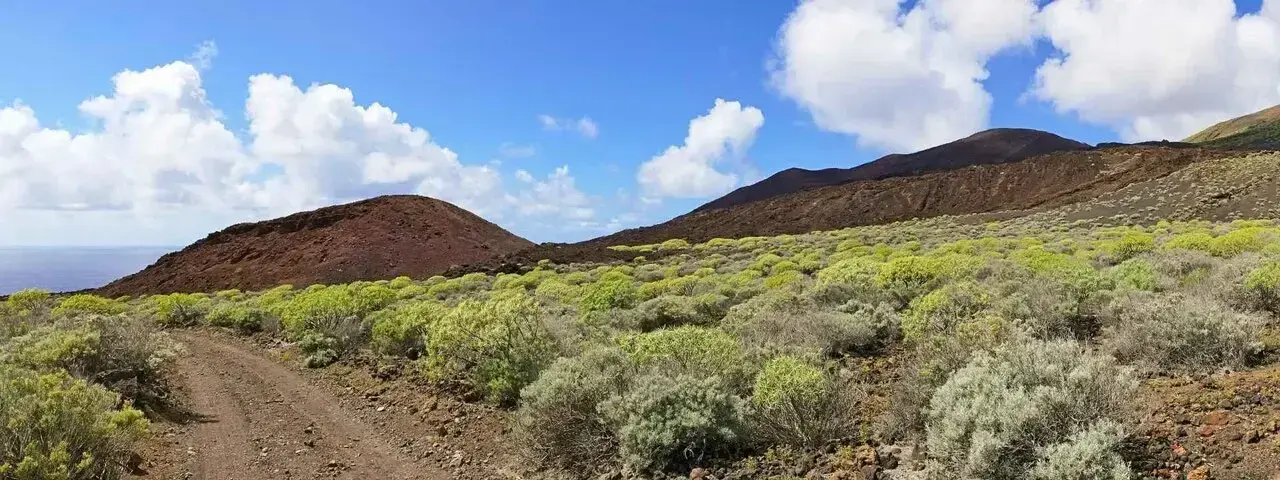
At the far western edge of the island of El Hierro, in the Canary Islands, stands a modest monument defying the wind. On a lava field melding into the Atlantic Ocean and surrounded by an eerie silence, the memory of a glorious past remains. Once upon a time and before the establishment of Greenwich Mean Time, this remote spot was the reference point for global cartography.

When El Hierro marked the prime meridian

Punta de la Orchilla marks Spain’s westernmost territorial limit. During Antiquity and prior to the discovery of America, this place was thought to be where the known world ended and the unknown began. It was in the seventeenth century when cartographers and sailors established this point as the axis of global geography.
El Hierro, nicknamed the Meridian Island, served as the reference point for defining the geographic coordinates and the world’s time zones for two centuries. Everything changed in 1884, after an international conference agreed to establish this imaginary line at Greenwich, England, a decision largely due to the clout wielded by the British Empire at that time.
A landscape of unusual beauty
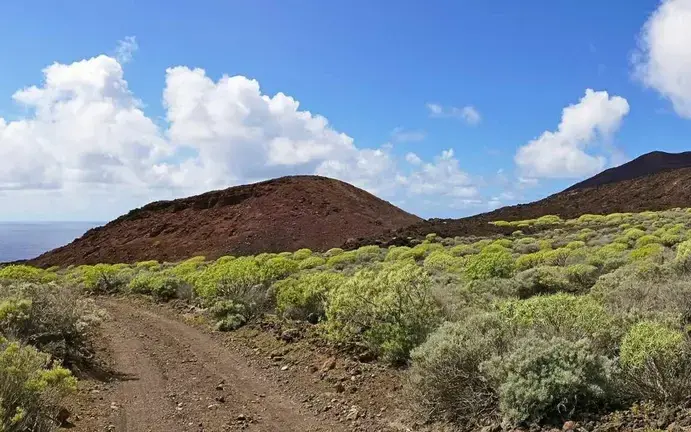
Although Punta de Orchilla ceded the world’s geographical reference point to Greenwich and subsequently faded into oblivion, it has not lost its mystical aura. A walk in the solitude of this otherworldly setting provokes indelible sensations.
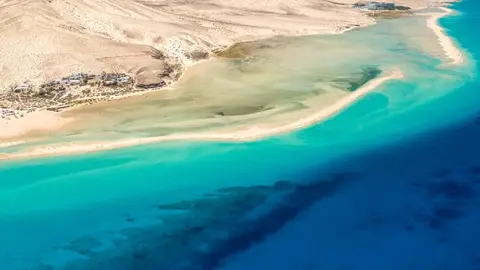
By day, a visual spectacle of competing terrestrial greys and dark oceanic blues opens before the eyes. As the hours pass, the landscape transforms itself into a warm medley of red hues and golden sunlight, resulting in one of Spain’s most beautiful sunsets. Once shrouded in the darkness of night, Punta Orchilla becomes an exceptional vantage point for stargazing.
Orchilla Lighthouse: guardian of sailors
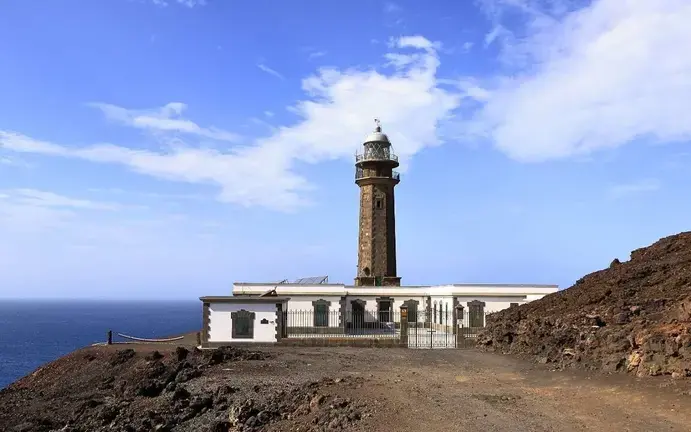
For nearly a century now, the figure of the Orchilla Lighthouse has stood out in this wild setting. The six years it took to construct the lighthouse was a titanic feat, as the stone used for this remote outpost had to be transported from the Arucas stone quarry in Gran Canaria.
The result of such effort has been one of Spain’s most bewitching lighthouses to date. While it may not be the tallest lighthouse, its defiant outline standing in the midst of nowhere imbues it with a unique vitality. While it may no longer be the world’s reference point for longitude, the lighthouse continues to be a place of relevance for maritime navigation.
Magical spots nearby Punta de la Orchilla
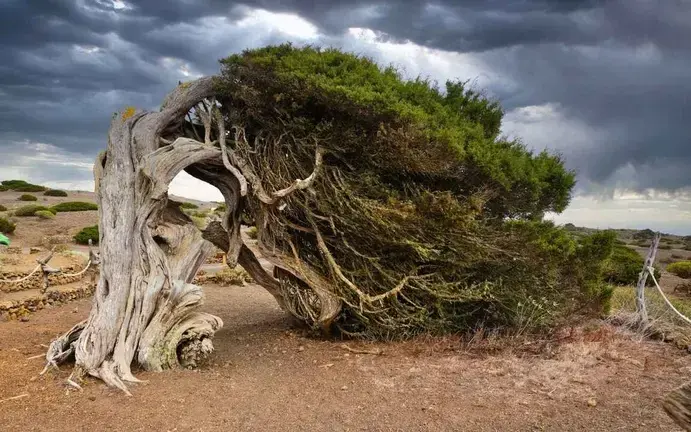
The seemingly inhospitable scenery at Punta de la Orchilla is, in fact, surrounded by little treasures showcasing El Hierro’s extraordinary natural plenitude. Not far from the foot of the lighthouse, an underground volcanic tube lies hidden, which leads to a cliff offering stunning views of the vast Atlantic Ocean.
Sabinar de la Dehesa, perhaps one of the island’s most unsettling landscapes, is located only a few kilometres away. An enchanting forest where the trees, shaped by the mighty force of the wind, have been twisted and bent in fantastically improbable ways.
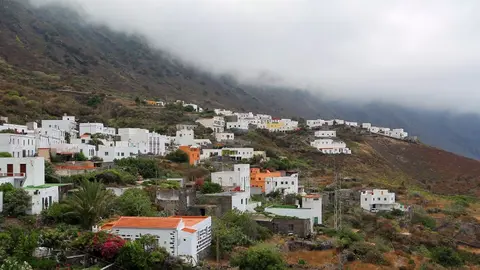
Towards the south, the clear waters enveloping El Hierro guard a treasure, hidden from the view of those who sail through the onetime prime meridian. Namely, the Restinga – Mar de las Calmas Marine Reserve, a place where the oceanic depths become an authentic underwater paradise.