
Travel Guide to Palma de Mallorca
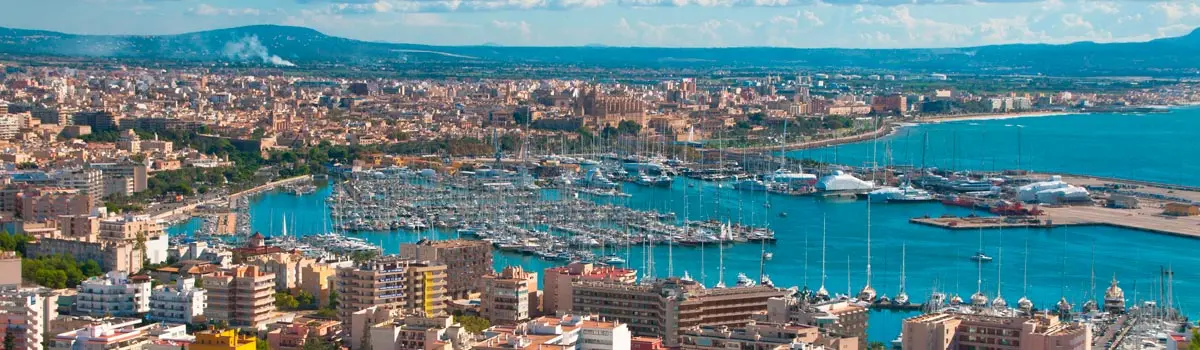
The lively eclectic city
Palma de Mallorca is the capital city of the island. Due to its privileged location and its riches, many people fought over it in the past. On another hand, Palma de Mallorca is a melting pot of different cultures. It has one of the liveliest atmospheres year round and all types of attractiveness. Are you ready to explore this travel guide to Palma de Mallorca?Plan your escape to Palma de Mallorca
Palma de Mallorca is one of the cities in the world with the greatest number of varieties of attractiveness which you can enjoy year round. It´s places of interest and artistic spaces are enough to explore for two days from one place to another. In this travel guide to Palma de Mallorca we will highlight the most important ones.
The possibilities for tours are numerous. There are endless places for trekking in the Serra Tramontana Natural Park. There you can find very charming places such as the Torrent de Pareis and other numeroud locations of great interest. These include Soller, Deià y Valldemosa. As far as the southeast, you can find the popular town of Andratx.
Up next, the history and continuation of the travel guide to Palma de Mallorca.Do you want to visit this place?
History of Palma de Mallorca
The travel guide to Palma de Mallorca is directly linked with it´s history. It is believed that the first settlement zone that occupies the actual city was a Talayotic settlement, the culture of the Balearic Islands. Prior to that, it was invaded by the Romans under the command of consul Quintus Caecilius Metellus. In the year 123 B.C: the city was founded under the name Palma.
The rest of this Roman core is found under the actual neighborhood of La Seu, the one in the cathedral. The wall that sorrounded the perimeter of the villa, resisted the prior ocupation of vandals and byzantines upon the fall of the Western Roman empire. After this, they would maintain Palma under their control for about three centuries.
With the Islam conquest in the year 902, Palma de Mallorca was baptized as Medina Mayurqa. From this perios of Arab domination, there are many traces n the city. An example of this is the Palacio Real de la Almudaina, the baths and Islamic city, burried upon the current one. After being assaulted and looted by Catalans y Pisans, it was conquered in 1229 by King James I of Aragon. He named it Ciutat de Mallorca. To erase the trace of the culture and Muslim religion, he built over the mosque a temple dedicated to Saint Mary. Today, the grandious cathedral of Palma is one of the most impresive sites in our travel guide.
The economic and commercial gowth that began from back then, has suffered a couple of times after. Such as when the Mallorcan farmers began to revolt from the year 1451. Also when the Revolt of the Brotherhoods reached its higherpoint from 1521 to 1523. This finished provoking a period of decadence in the city.
A couple of year later, in 1562, the past medieval wall was replaced by another that would be resistant to the bombings of the ottoman pirates. These would constantly attack the archipelago. When Phillip V passed the Nueva Planta Decrees in 1715, the villa recovered the Roman given namde of Palma. The use of catalán was prohibited and the municipal government regime was separated from the rest of the island.
Practical data
PRACTICAL DATA
39° 34′ 0″ N, 2° 39′ 0″ E
Aeropuerto de Son San Joan 8 km, Sóller 24 km, Manacor 53 km,
Pollença 60 km
0-13 m
398 162 (2013)