San Juan de la Peña
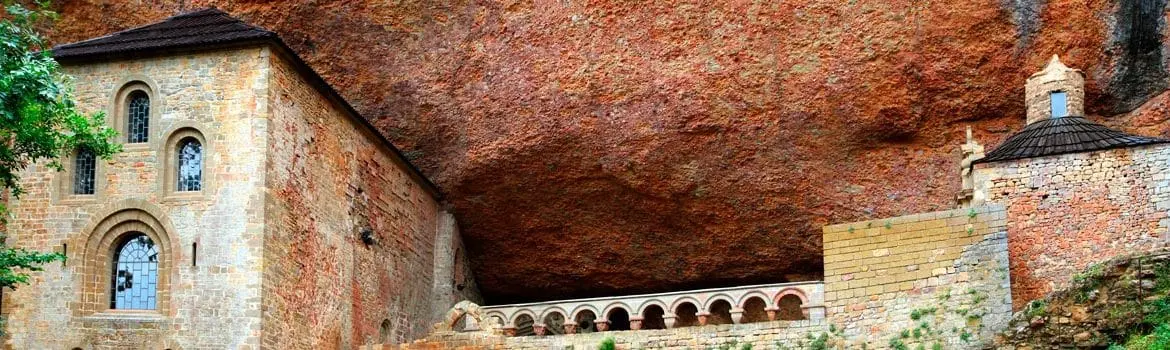
The monastery inside a cave
It is an unusual monumental site located seven kilometers from the town of Santa Cruz de la Serós in Huesca. It is perched in a surprising place that Miguel de Unamuno described as "the mouth of a world of spiritual rocks covered with a forest of legend".Plan your stay in San Juan de la Peña
To make the transfers and to visit what there is to see in San Juan de la Peña, it takes no less than two hours. Then we recommend you to go up the A-1205 road to visit the monumental city of Jaca. There it is also possible to contract numerous activities of active tourism that are offered in the Natural Park of the Western Valleys. The excursion can continue up to Canfranc, where there is a historic rail station recently themed. To know the dishes and be able to book an accommodation, we prepared the page Sleep and Eat in San Juan de la Peña.Do you want to visit this place?What to see in San Juan de la Peña

Nowadays, San Juan de la Peña is one of the greatest artistic representations of the Romanesque period in Spain and one of the main tourist landmarks of Aragón. The two spaces that make up the set have been adapted to the tourist interpretation, complemented by a hostelry, a museum and two interpretation centers.
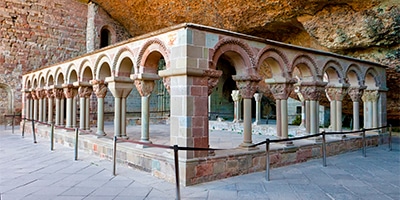
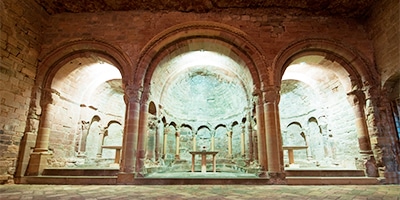
There is much to see in San Juan de la Peña: the Old Monastery is located under the weight of a huge rock that seems to cover it completely while directing the very appearance of the place, digging the rock itself in several of its corners. It consists of two levels, being the superior fruit of the reforms undertaken from 1071. On the ground floor is the first Mozárabe Church, excavated in the rock, and the so-called Council Room. The Upper Church, consecrated in 1094, consists of a broad nave crowned by three semicircular apses. The legend tells that the central protected for a season the Holy Grail itself. Then, the Pantheon of Nobles shows several tombs embedded in the rock, many of which has in its ornamentation with checkered jaques. At the end of the visit you will arrive at the true jewel of the monastery, which is none other than the Cloister. Under the shelter of the rock, two of the four lines of arches topped by valances of taqueado jaqués that make up the original set are distributed in very good condition. The capitals stand out, works of the Master of Agüero (a reputed Romanesque artist of unknown name), which as a whole constitute a whole lesson in biblical history.
Practical data
PRACTICAL DATA
42° 30′ 27.77″ N, 0° 40′ 23.81″ W
Huesca 74 km, Zaragoza 145 km, Barcelona 446 km, Madrid 460 km
1115 m (Monasterio Viejo) y 1212 m (Monasterio Nuevo)