Seville's Holy Week
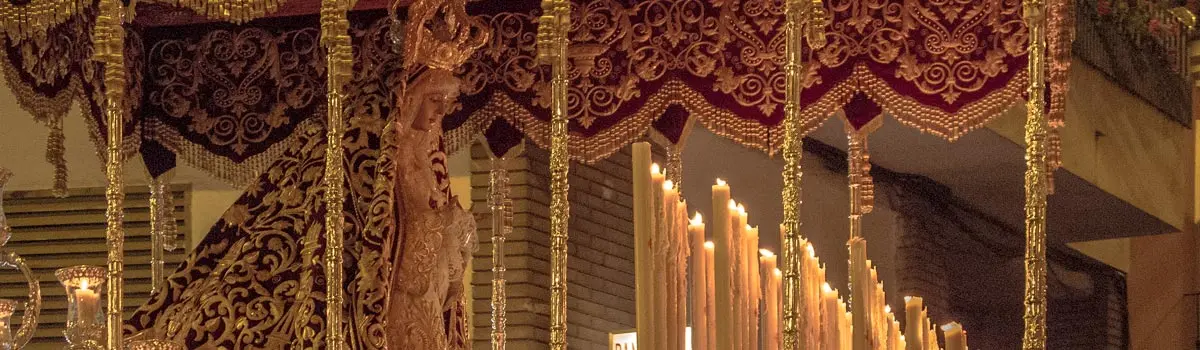
Holy Week in Seville is probably the most famous in Spain. It is an event of exceptional character and solemnity.
The current characteristics of Seville's Holy Week began to be drawn between the 15th and 16th centuries, when the brotherhoods of penance and passion began to act as processional groups. One of the most significant regulations was established in 1604 when all the fraternities were forced to hold a penitential station towards the cathedral.
Only the brotherhoods of Triana remained out of this arrangement due to the difficulty of crossing the plank bridge that linked the quarter with the rest of the city. From then on, the Sevillian Holy Week grows and develops times of great splendour. There were others of crisis as the one experienced in all Spain during the 19th century. It was a result of an adverse economic situation that begins to revert after the Bourbon restoration, coinciding with a time defined by the tourism boom. During the Second Republic, there was another crisis due to the refusal of the brotherhoods to go out in procession.
In 1932 the Brotherhood de la Estrella was the only one to parade on Holy Thursday. In its path there are some riots and an anarchist manages to shoot the image of the Virgin. Once the Spanish Civil War was over, and the 20th century advanced, Seville's Holy Week was once again definitively consolidated.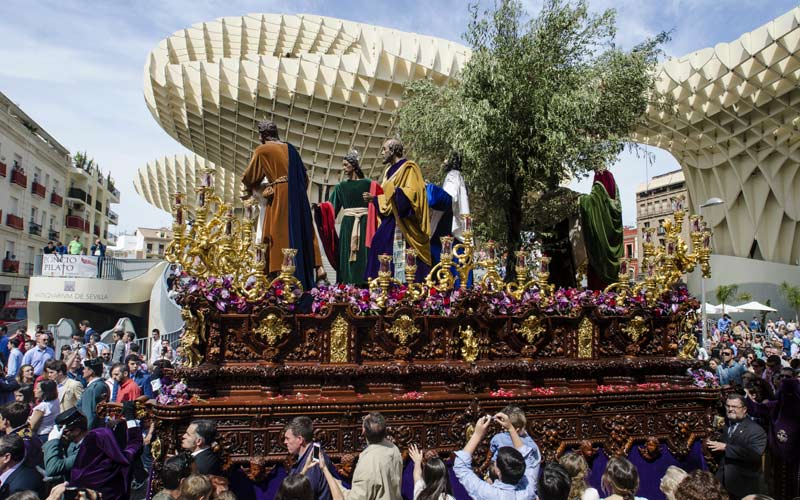
Generally, the brotherhoods are joined by music bands that play different hymns of the Holy Week. Examples are Quinta Angustia, Amargura, Virgen del Valle or Rocío. In addition, at certain points the saetas sound. They are distressing popular songs sung at streets or balconies as the images pass by. At the head of the parade is the cross of the guide. Behind it, others carry elements such as the rulebook, the standard, with the embroidered shield of the brotherhood, or the senatus. The latter is a symbol alluding to Roman iconography in which the signs S.P.Q.R, Senatus Populusque Romanus, are shown.
Floats, on the other hand, are usually the most colourful part of the parades. They are made in accordance with artistic precepts of a high sculptural level and reflect moments of the Passion of Christ or enhance the image of the Blessed Virgin Mary.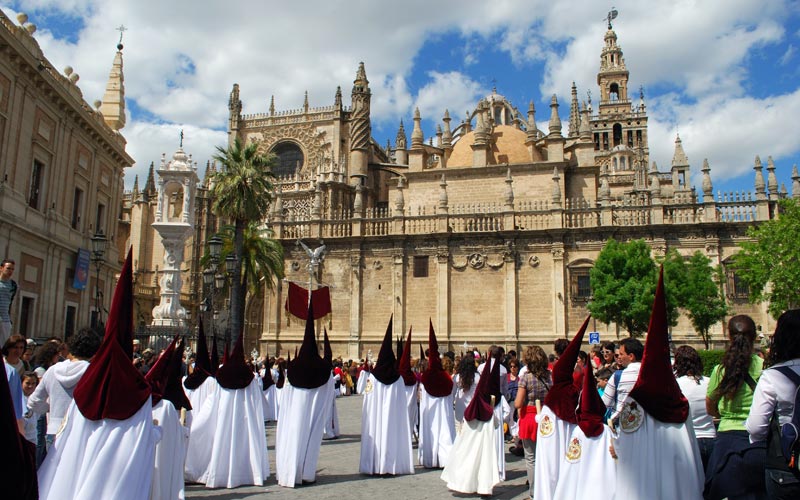
The procession then runs along Sierpes Street, San Francisco Square, Constitución Avenue and finally arrives at the cathedral. Another special moment is La Madrugá, which takes place during the night between Good Thursday and Good Friday. Its importance lies in the fact that while it lasts, the order of departure of the processions is reversed. Therefore, the oldest ones parade first, leaving the youngest one in last place. The rest of the days, the different brotherhoods carry out processions according to the calendar set by the General Council.
The Holy Week of Seville is one of the most important celebrations in Spain, as well as one of the most recognized popular and religious events beyond our borders. It is an occasion to enjoy the traditions of Seville's Holy Week. And the essence of a city that becomes a solemn centre of religious feeling and popular attraction for a week.
Main image: Genlab Frank