
Madrid — Festival of la Paloma

In mid-August, the Festival of la Paloma in Madrid closes out the trio of summertime festivals in the capital city
Sometime in 1787, a group of Santa Juana nuns discovered a painting of the Virgin Mary which they called Virgen de la Soledad (Virgin of Solitude) due to the expression on Mary’s face. The painting was later purchased by Madrid native Isabel Tintero, who displayed it in the entrance hall of her home on Calle Paloma. As sometimes happens with religious images like this one, a rumor soon spread that the painting of the “Virgen de la Paloma” (“Virgin of the Dove”) was capable of working miracles, and it became a pilgrimage site for the common people of the neighborhood and other areas of Madrid. Due to the painting’s fame, it was moved to the main altar of the Church of San Pedro el Real, where it remains today. Since 1798, the La Latina neighborhood has celebrated a verbena in honor of the Assumption of Mary which has gradually become a festival to honor the Virgin of la Paloma. In the 21st century, the painting of Mary is paraded around the streets in a procession by the fire department of Madrid, of which she is the patron saint.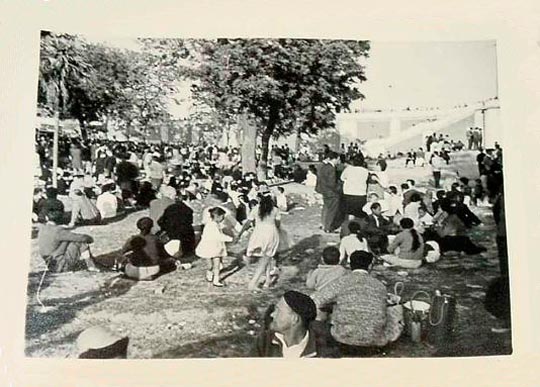

The Festival of la Paloma in Madrid takes place every year around August 15th in the La Latina neighborhood of the city. Its main venues are Plaza de la Cebada, Plaza de la Paja, Calle Toledo and the surrounding area, and especially Las Vistillas Gardens. On the morning of August 15th, there is an offering of flowers followed by a mass. Afterwards, representatives of the fire department of Madrid take the painting of Mary down from the altar, mount it on a float, and parade it around the streets of the neighborhood. This ceremony draws a crowd of spectators from all over Spain, some of them dressed in chulapos and chulapas, who cheer and whistle as the firefighters pass by carrying the painting on their shoulders.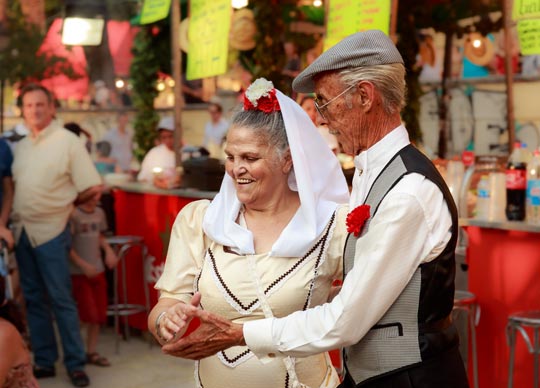
The festival is integral to popular conceptions of the La Latina neighborhood in particular, but also of Madrid as a whole. Its popularity was documented by the 1894 operetta La verbena de la Paloma: El boticario y las chulapas o los celos mal reprimidos, with a libretto by Ricardo de la Vega and music by Tomás Bretón. Madrid’s devotion to the Virgin of la Paloma was also noted by Azorín, who wrote that the Virgin of la Paloma “is not the patron saint of Madrid, but she reigns fully in many of the humble hearts that inhabit the city.”
Main photo: José Javier Martín Esparto