Highlights of the Guggenheim Museum Bilbao
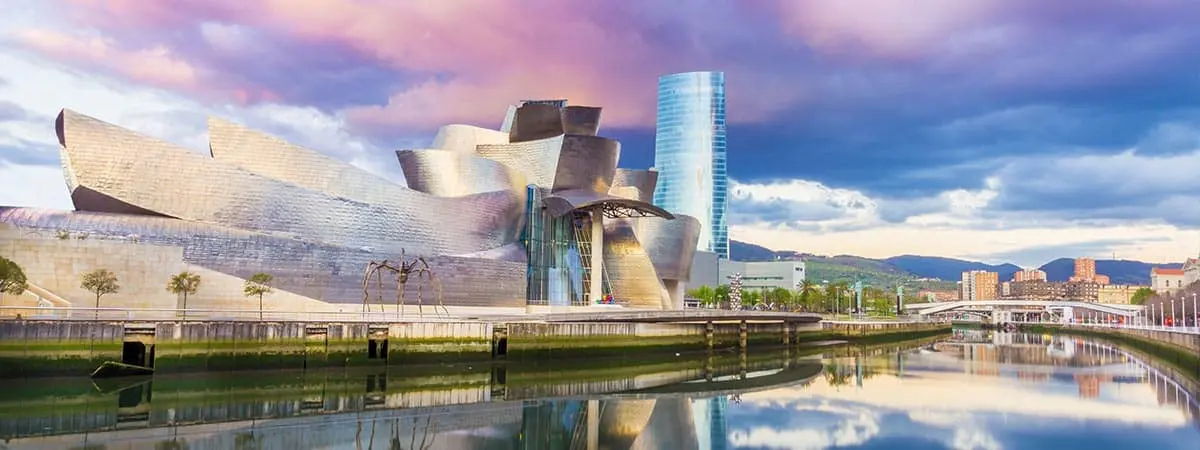
The Guggenheim Museum Bilbao is an institution for contemporary arts dependent on the Solomon R. Guggenheim Foundation, the Provincial Council of Biscay, the City Council of Bilbao and the Foundation Vizcaina Aguirre. It is located in the banks of the Nervión’ estuary in Bilbao, Biscay.
Frank Gehry and the Guggenheim Museum Bilbao
The building that holds the museum was designed by Frank Gehry and it is one of the most fascinating examples of postmodern architecture in Spain. The project of the construction was done between 1993 and 1997, in the old pier of the Nervión estuary.
This construction meant a recovery of this area, as well as an important impulse for the offer of culture and leisure of the city. Due to its design and the complexity of the curvilinear shapes, Gehry used a software from the aerospace sector in order to express his architectural project accurately.
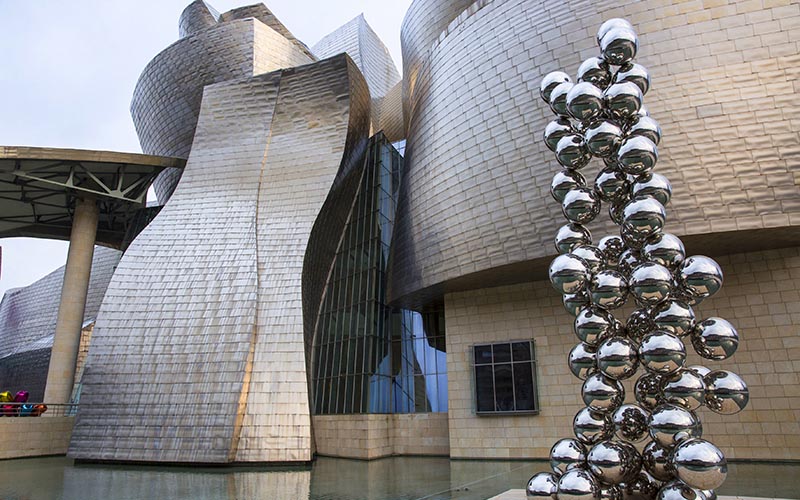
The structure of the museum is made up of 33,000 thin titanium plates that are combined with other elements in limestone and glass. Different chromatic effects are generated depending on the prevailing atmosphere thus. Its design and configuration make it an ideal building for the collection it houses.
The atrium is the heart of the Guggenheim Museum Bilbao. It is a large diaphanous space where curved shapes predominate. A series of glass curtain walls connect the interior and exterior, and a large central skylight illuminates the room. Gehry sought to create a sculptural structure that would be integrated into the urbanism of Bilbao.
Essentials
Many works are outdoors. A giant West Highland Terrier covered by flowers guards the museum entrance doors. It is Puppy, a sculpture made in 1992 by Jef Koons. Its inner structure is made up of stainless steel. The flowers make different figures of vegetables and puppies.With this sculpture Koons evokes the classic European garden of the 18th century. In addition, it includes references to contemporary culture. It might be the most iconic and remembered piece by the visitors of the Guggenheim Museum Bilbao.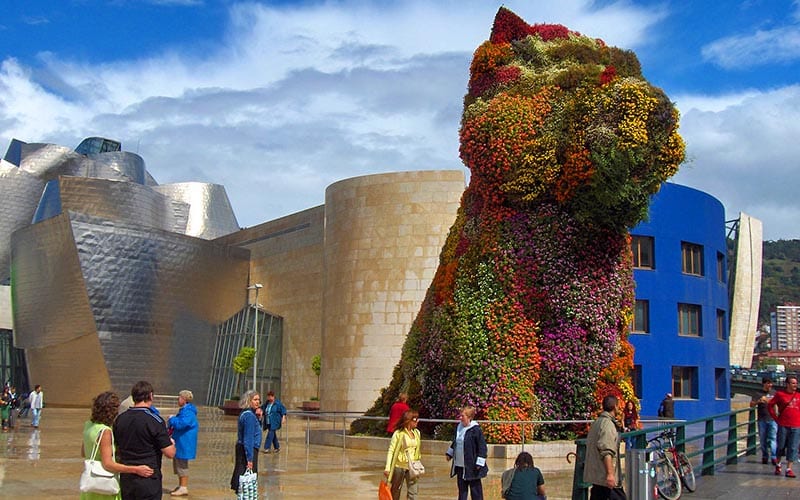
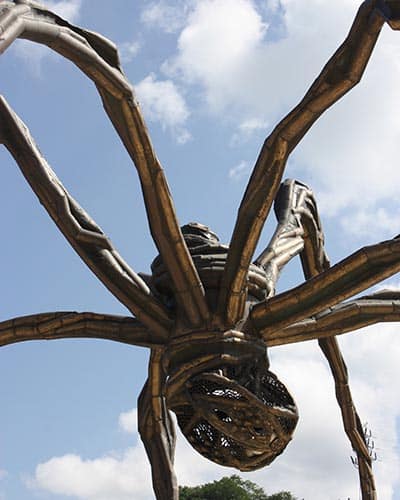
It shows the duality of maternity: protector and predator since the spider uses its silk both to fabricate the bud and capture its prey. The mother’s legs worked as a cage and as a den that holds the eggs found in its abdomen. 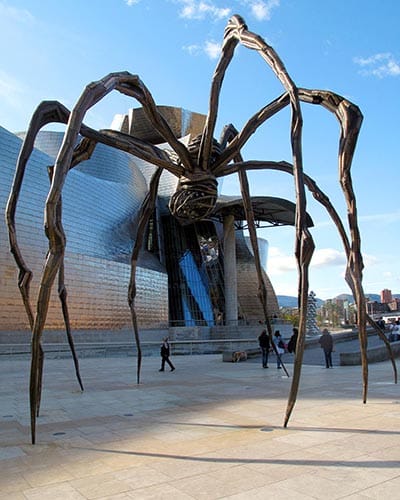
Koons transforms an ordinary element (such as the tulips) into something hard, notable and shiny. Tulipanes is an sculpture that transmits a sense of optimism to the spectator, as well as a great colouring. Its colour and originality make that it is one of the most photographed works by the visitors of the museum.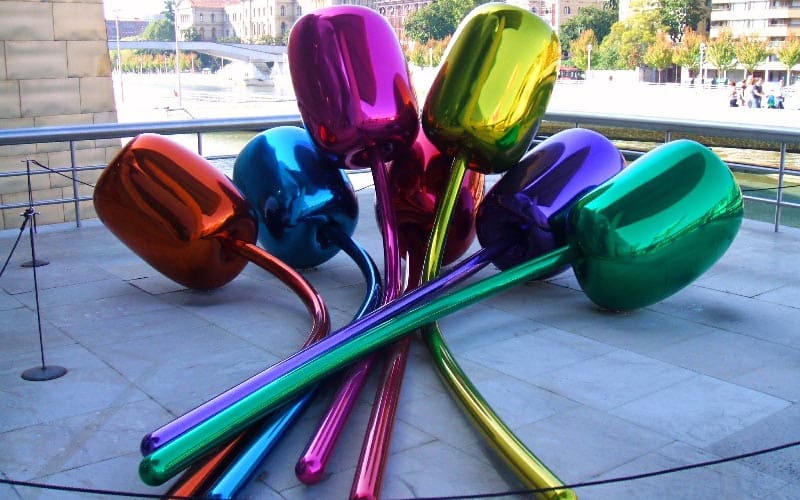
This masterpiece of the Guggenheim Museum Bilbao allows him to experiment with games of lights and shadows, as well as the processes of disintegration and decomposition of shapes. The fog also acts as a moulding element of its environment.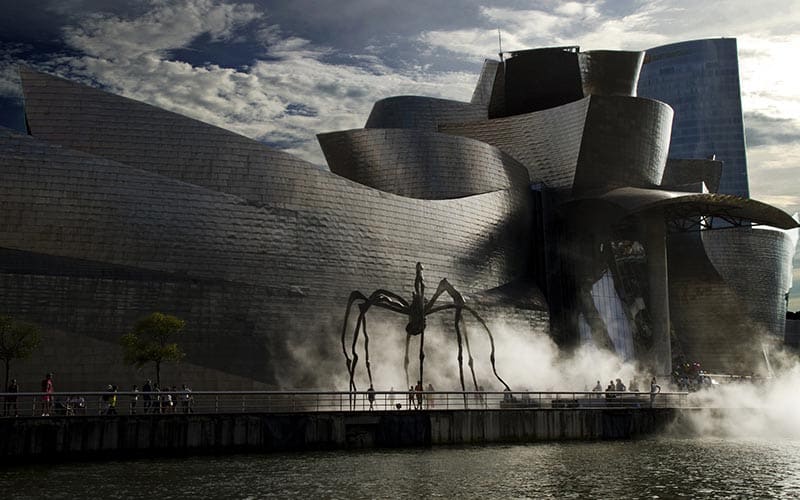
As you go through the different sculptural forms, a dizzy sensation of space and movement is created. You can also perceive the passage of time. On the one hand, the chronological time it takes you to travel through it and, on the other, the time of experience in which forms are combined in space.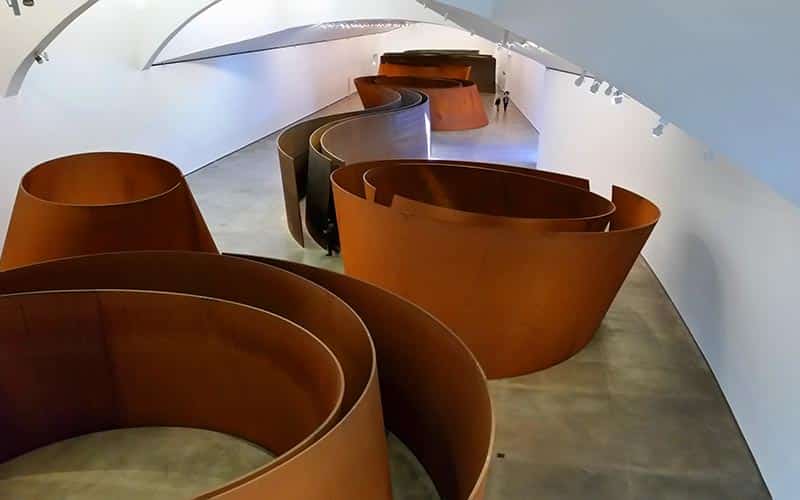
Plan your visit to the Guggenheim Museum Bilbao
Location: Museo Guggenheim Bilbao. Avenida Abandoibarra, 2. 48009 Bilbao.GPS coordinates: 43° 16′ 6.98″ N, 2° 56′ 3.43″ O.
Phone: +34 944 35 90 80.
Website: Museo Guggenheim.
You can get to the Guggenheim Museum Bilbao by both public or private transport.
By underground: ‘Moyua’ stop, ‘Ercilla-Guggenheim’ way out
By bus:
- Routes 01, 10, 13, 18 and A7 at the stop: ‘Museo 1 / Henao’.
- Routes 13, 27, 38 and 48 at the stops: ‘Alda. Recalde 31 and 11’ and ‘Alda. Recalde 12’.
- Routes 11 71 at the stops: ‘La Salve / Igogailua’ and ‘Campo Volantín / La Salve’.
The extraordinary Bilbao Fine Arts Museum is very close.
If you plan to stay longer in Bilbao, here you have some recommendations to discover some secret places, try tortilla de patatas or Basque pintxos.