Medina de Pomar
The feudal grant of the Velasco family
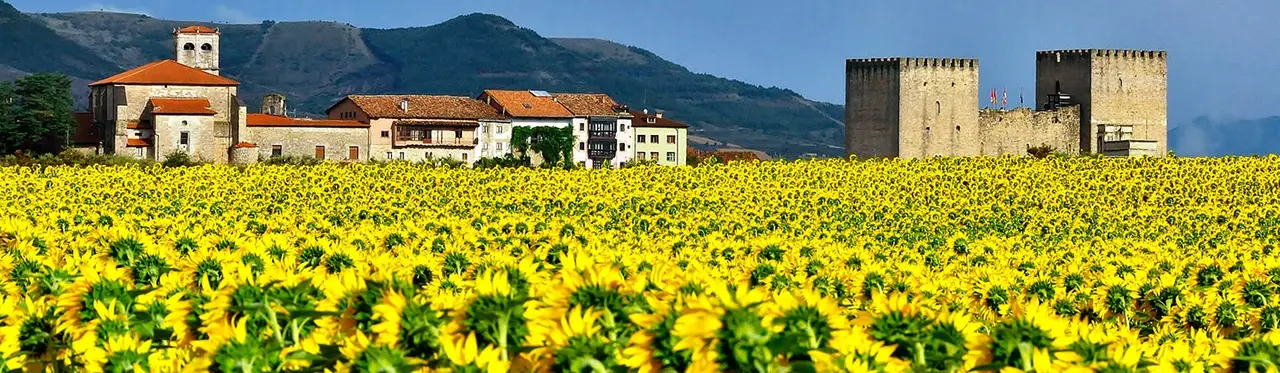
The ancient Capital of the Merindades from Castille was the place where the Emperor and other Kings went for a walk on the way to Laredo and the European North; even though it is not a capital anymore, this place maintains its old charm thanks to the Alcázar from the Velasco and the high towers created by Rafael Alberti.Plan your journey to Medina de Pomar
This area has a beautiful ancient center with numerous mansions, a Jewish quarter and buildings such as the Alcázar de los Velasco; in order to understand the importance of this place in the history of Castille, you should start by visitng the Historical Museum from the Merindades. In just half of a day you should be able to walk around the whole town. But the urban center is not the place where the best part of the village is, as the Convent and Museum of Santa Clara is the most incredible spot here. The visit can continue in the North, in the also medieval Espinosa de los Monteros, a place that has another interesting historical museum. For the haking lovers and those who like other touristic activities, you can spend a day in the Natural Park of the Hoces del Alto Ebro and the Natural Park of the Montes Obarenses. There are many places where you can enjoy the local gastronomy; to make a reservation in the place where you want to sleep at we have selected hotels that are available in our eating and sleeping sections.Getting to know this placeHistory of Medina de Pomar
This place belonged to Cantabria before the arrival of the Romans, and there is some evidence that it also belonged to the Law Convent of Clunia. Because it was founded twice, the second time is thought to have been by the hands of the Mozarab that migrated to the North; due to the Arab culture and the commerce with the previous inhabitants, the Mozarabs gave the city the name of Medina, which means "city" in Arab. The previous name of Medina de Castella Veteris was changes by Medina de Pumar so it could be differenciated from the other "medinas" that were in Castille La Vieja. After getting its first regional code of laws thanks to the king Alfonso the 7th, Alfonso the 8th gave the city a new one during the year 1181. This last one reinforced its condition of royal city, appearing in the famous book from Becerro de Behetrias as if it was a property of the king. This stayed like that until the year 1369, when the king Enrique the Second of Trastámara gave it to his major waiter, D. Pedro Fernández de Velasco. This family had had the title of Condestables of Castille since 1474. The presence of this family in the village turned it into the capital of the Merinadades until 1650, and gave it the architectonic development that remains until today. During the Revolt of the Comuneros the inhabitants rised up against the Velascos, being reduced after a siege. Carlos the 5th also passed by Medina on his way to Yuste, and it seems that his daughter Juana left him some provisions there, so many that the old man got ill for eating too much.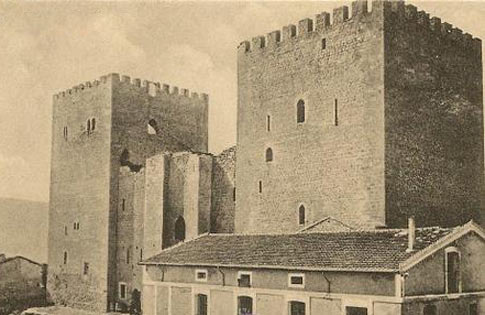
What to see in Medina de Pomar
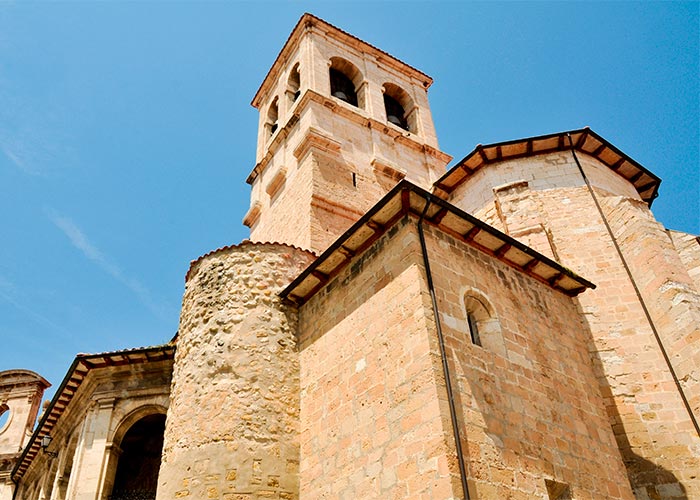
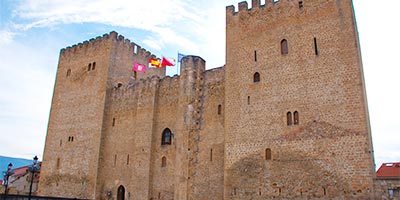
To visit Medina de Pomar you should start with the Plaza del Buen Conde de Haro, a nice place that has a fountain where thw statue of Juan de Salazar y Espinosa is, the founder of the capital of Paraguay. This square is the union between the ancient center and the new buildings. The Calle Mayor and the street of Laín Calvo allow walkers to reach the historical center. This is where some parts of the old walls from the 14th Century reamin, which hold the Arco de la Cadena, a northern door to the medieval area. The Arco de la Judería from the 17th Centry is located in the west. The church of Santa Cruz is stuck to the walls. This place has Neoclassical doors from the 19th Century, an angular shape and a Gothic interior from the 15th century. It holds Pre-Renaissance tombs and Barroque retables. The Plaza Mayor holds the city council (1989), raised above elegant porticos. The viewpoint located in the interior offers a beautiful panoramic above the vegetable gardens and the Truba river. The Alcázar from the Velasco family is a powerful Gothic building from the 14th Century, formed by big cubic towers that are united by a central body that is shorter, where the living room of the castle was built and that could be entered through spiral stairs. It maintains the walls in great condition and the remaining parts of the Mujedar plaster works. The southern tower conserves another baseboard with Arabe insciptions, African characters and Kufic letters where it is possible to read the sentence "Mater Dei Miserere Mei". The arabe characters are translated as "Ala is the only winner". This area is used as the noble living room for conferences, meetings, summer classes and the archive of the municipality.

The Alcázar was built by Pedro Fernández de Velasco betweem 1370 and 1433. In the year 1896 the dukes of Frias gave it to the city hall. In 1933 it was declared a Cultural Interest Property. The Historical Museum of the Merindades, located in the Fortress of the Velasco, explains the history, archeology and patrimony of the region. In the terrace of the last floor you will get a beautiful view of all of the villages and the merindades. You will need a guide to be able to get into the northern tower.
Outside the urban center and on the way to the south, close to the Trueba river, the Santuray of the Virgen del Rosario, a Gothic temple of the 13th and 14th Centuries, is located, with Romanic ellements and three naves. Nowadays, this place is under restoration. Not too far away from that, the main monument of Medina de Pomar is located: the Convent and Museum of Santa Clara. It was founded in 1313 by Sancho Sánchez de Velasco and his wife Sancha García, The Major Waitress of Leonor from Aragon, to become the cemetery of the Condestables family. This Cultural Interest Property is nowadays inhabited by a community of Clarisas. The church of one only nave is formed by three spaces of different times and styles, as it can be seen of the domes located in different heights. The Major Chapel has three retables covered in gold leaf; in the central one (Baroque from 1774) we can find the remarkable tabernacle known as the "Manifestador de la Paloma". The Chapel of the Concepción has a beautiful octogenarian domes with stars that reminds us of the Chapel of the Condestables from the Burgos Cathedral. The bars that work as the entrance where made in 1545 by the master Cristóbal de Andino. There is a region with glass cabinets where many objects of monastic use are exhibited, such as bowls, jars, a communion window Rococo style and vases.
Must see
Practical data
PRACTICAL DATA
42º 55’ 40’’N, 3º 29’ 12’’W
Burgos 80 km, Bilbao 66 km, Madrid 336 km
Sin dificultad. Además hay una explanada “El Ferial” junto a la Plaza de Toros donde siempre hay espacio.
583 m
6050 (2013)