Hospital de Órbigo
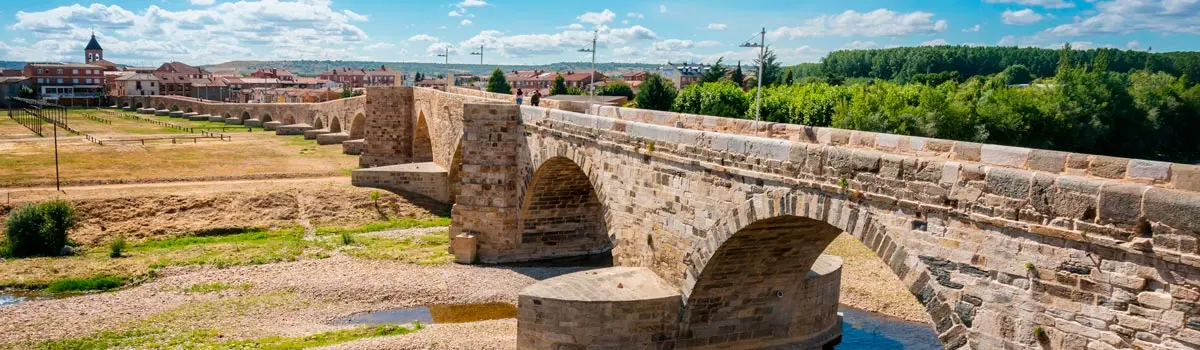
The epic bridge of the Passo Honroso
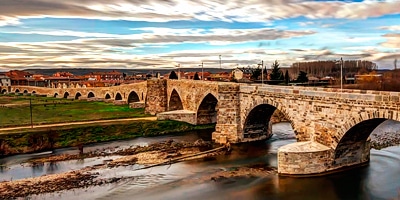
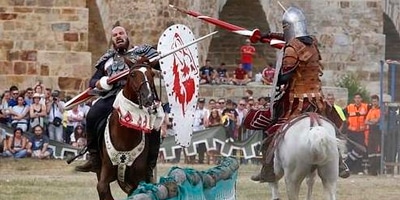
This small town, large in importance as a stage of the Camino de Santiago, is the head of the fertile valley irrigated by the Canal del Páramo and known for its medieval bridge. It forms an important part of the history of the cavalry because there was celebrated the passage of arms of the history, July of 1434.Plan your stay in Hospital de Órbigo
The main thing to see in Órbigo Hospital is the bridge was held the most famous “passage of arms” in history. The getaway can continue to the west to visit for a full day the important Astorga. Another option is to go in the opposite direction to the city of León.Do you want to visit this place?History of Hospital de Órbigo
It is a place of the channel of the river Órbigo in which this one has favorable conditions for its ford; So it has been populated since ancient times. Due to this, the Romans built a bridge for the causeway that connected Leon with the provincial capital of Astorga on whose foundations later works were realized. In the left bank a first nucleus of population was formed to give service to the travelers who had to cross it; This motivated the construction of a temple that would be dedicated to Santa Maria.
On Friday, October 5, 456, the Suevian troops of the Requiem King attempted to prevent the invasion of their territory by the Visigothic army of King Theodoric II; The Suevi were defeated and Requiario fled.
According to a local tradition, during the history of Hospital of Órbigo by its bridge crossed the army of the caudillo Almanzor in the year 997; Transporting to the south the booty obtained in the sacking of Galicia, including the bells of the Cathedral of Santiago de Compostela.
Towards the year 1184 the hospital knights of the Order of San Juan of Jerusalem establish in their environs an encomienda, directed by a resident commander; On the right bank of the river were built a hospital and a church to attend to the pilgrims from Santiago de Compostela, who had to travel there, on the way to Astorga.
The place is part of the history of the cavalry because in its margins took place the epic story of the honorable Passo, starred in 1434 by the rich and influential gentleman Suero de Quiñones, accompanied by nine other gentlemen, for a month was against How many gentlemen tried to cross the bridge. This historical fact of cavalry was collected by Cervantes in Don Quixote.
What to see in Hospital de Órbigo
The main thing to see in Órbigo Hospital is the bridge was held the most famous “passage of arms” in history. The getaway can continue to the west to visit for a full day the important Astorga. Another option is to go in the opposite direction to the city of León.In November of 1808 the army of the English general Moore retired towards Galicia by the pressure to which the French army to him commanded by Napoleón Bonaparte in person; He tried to destroy every bridge he encountered in order to delay the advance of his pursuers. They had a skirmish with the French on the right bank of the river to gain time and dynamite both sides of the bridge, destruction that little delayed the advance of their enemies.
In 1890 the Blanco brothers of Sierra Pambley founded a secondary school and agricultural training there, according to the teachings of the Free Institution of Teaching promoted by Francisco Giner de los Ríos.
The long and irregular Bridge, although greatly refurbished throughout its history, preserves part of the structure of the thirteenth century, the arched ogival of the center today leaning on a dry river bed. Before the construction of the reservoir of Barrios de Luna this one was very mighty. It is a national monument since 1939. It is located on the Roman road from Leon to Astorga. In the restoration of 1951 imposes a plaque that remembers to Suero and the main knights with whom it broke spear. Another reform has been tendered since 2009.
At the exit starts the Main Street in whose tour you can admire the typical white and blue houses of the historic village. From there you can reach the Plaza Mayor.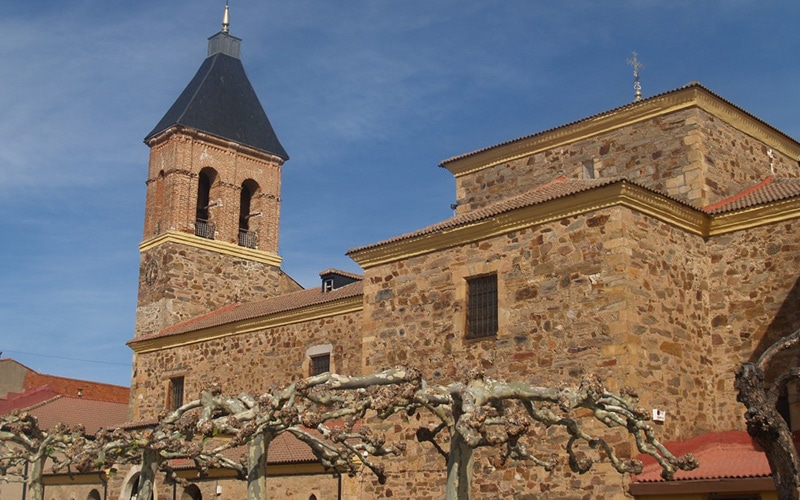
Also in the Plaza Mayor is the Monumental Cruiser.
Aguas arriba del Órbigo can be visited in Carrizo de la Ribera, the Monastery of Santa María, founded in 1176 by Countess Estefanía Ramírez and inhabited since then by Cistercian monks. The church of three naves has head with central apse and small absidiolos decorated with fancy canecillos that next to the flared side cover corresponds to the construction of the XII and XIII centuries. The rest of the building was renovated in the 17th century.
The Monastery of San Salvador originated as an abbey founded by Count Sancho García in 1011 as a retreat for his daughter Trigidia. The abbey was initially conceived as a co-ed convent with two communities of different sexes who shared the facilities but reported to separate male and female authorities. In 1033, King Sancho III the Great of Navarre handed the abbey over to the Clunic monks. It was put under the direction of a chaste abbot who would be canonized as San Íñigo, who made the abbey a center of culture and spirituality. San Salvador enjoyed some privileges which were expanded when it was converted into a royal mausoleum. In reality there are two mausoleums: the royal mausoleum housing the bodies of the monarchs of the kingdoms of Castile and Pamplona, and the counts’ mausoleum where the counts of Castile are buried. It contains eight coffins and nine people from the 11th and 13th centuries. The coffins are unique pieces due to the material from which they are made, walnut and boxwood. The resting place of Bishop D. Pedro López de Mendoza was moved to the sacristy of one of the church’s naves.
The great entrance terrace leading to the most modern part of the building is behind the 18th-century Baroque façade. To get to the church of the abbey, you have to go around the building and ascend a long staircase. The portico, built in the last quarter of the 11th century in the Romanesque style, is decorated with statues of kings. An engraved Gothic-Mudejar door leads into to the church. The 13th-century Gothic church preserves Romanesque remains from different periods. The front of the church, built in the late Gothic, is covered by a spectacular star-shaped dome with eight points. It consists of a single nave with three sections and several chapels. The wall to the right-hand side conserves various scenes from the poem La Vida de Santa María Egipciaca, in the linear Gothic style, and El Cristo de Santa Trigidia, in the French Romanesque style. There are also remains of the main altarpiece carved in walnut wood with boxwood insets, a 15th-century Gothic-Mudejar work by Brother Pedro de Valladolid, and scenes from the Passion of Christ, painted by Brother Alonso de Zamora (15th century), as well as a Baroque organ from 1786 consisting of over 1,100 tubes.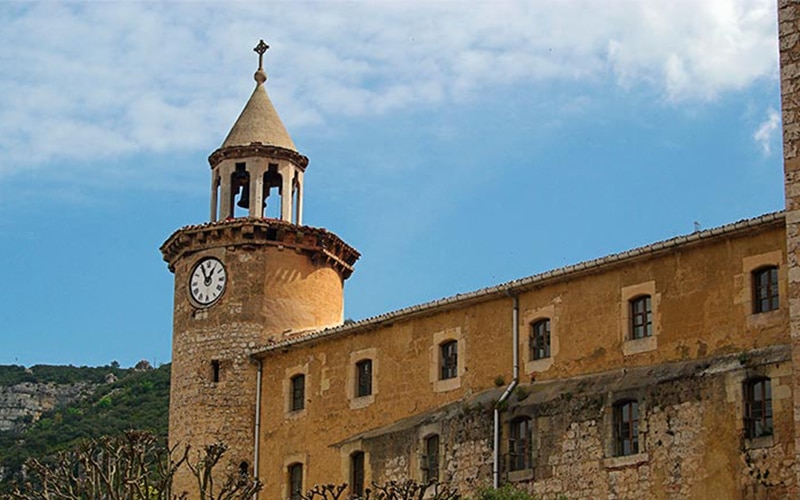
In the chapterhouse there are windows, currently blocked off, of the Romanesque building which connected this room to the cloister. They are beautiful semicircle arches decorated with diamond tips and capitals shaped like animals. You can even make out a good deal of the original polychrome. Polychromatic arches in the Romanesque style, surely coming from the refectory, are also preserved. The main cloister of the Monastery of San Salvador, also Gothic, is an early-16th-century work by Juan de Colonia. Four galleries with ribbed vaults form a trapezoidal floor. It houses numerous burial sites of counts and Castilian paladins. In 2012, the seventeenth exposition of Las Edades del Hombre took place in the Monastery of San Salvador.
Tours of the monastery are directed by an audio guide, except for previously organized groups who can arrange for a guided tour. The visit to the tower and the Medieval Visitors Center can be arranged at the City Office of Tourism (tel. 947 30 00 78).
The Visitors Center of the Monastery is located on Calle Barrusco in the Jewish quarters.
In the old cowshed of the monastery, you’ll find the Information Office where you can get information about the Natural Park of the Obarenes-San Zadornil Mountains.
Must-see...
Practical Data
PRACTICAL DATA
42º 27’ 40’’ N, 5º 53’ 3’’W
León 32 km, Valladolid 143, Madrid 323 km
820 m
1003 (2013)