
Pontedeume
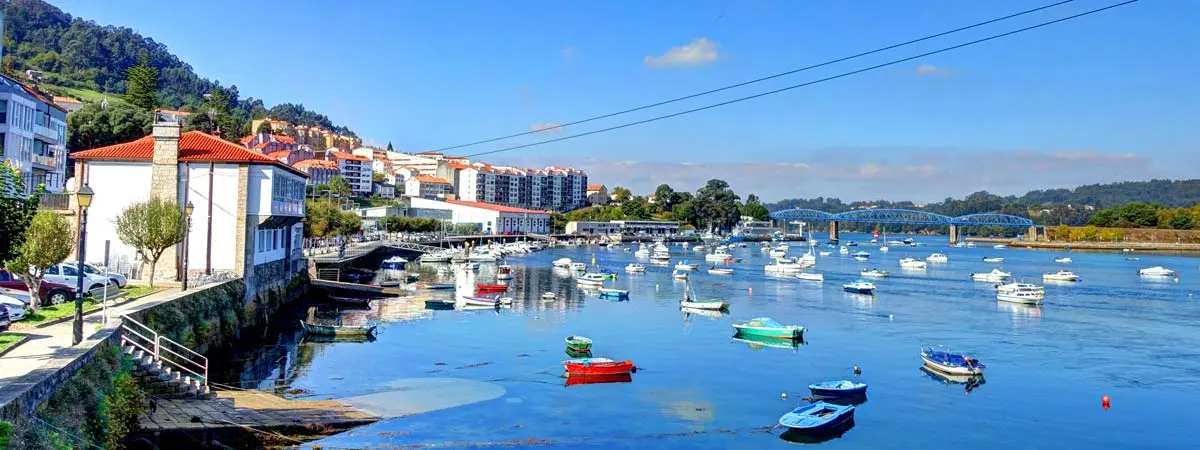
Home of the Andrade Family’s Bridge
Pontedeume is a beautiful town and vacation destination which has developed over time thanks to its historical and heavily-trafficked bridge. Located at the mouth of the Eume River and on the side of Breamo Hill, it maintains its medieval feel and preserves the legacy of the Andrade family, who played a pivotal role in the town’s growth.Planning your trip to Pontedeume
When it comes to things to do in Pontedeume, there are enough sights to last an entire day. In the surrounding area there are plenty of places to spend the rest of your trip. First, there’s the important Fragas do Eume Natural Park, with lush plant life and tons of options for hiking, also the site of the monasteries of Caaveiro and Monfero. If you want to see Galician folk architecture, the Gothic style, and a place with a medieval feel, nearby Betanzos (the Andrades’ other stronghold and the stage of the Irmandiño revolts) is a good option to complement your trip to Pontedeume. If you’re looking for a more urban setting, you can spend one or more days in the nearby city of La Coruña. To experience an authentic Galician seaside town, you can find the beautiful port town of Cedeira less than an hour to the north by car. In summertime, you can enjoy beautiful views and go for a swim in the cool water of the Ares and Betanzos Rivers. To help you choose a place to stay and which local dishes to try, we suggest our pages about sleeping and eating in Pontedeume.Want to Get to Know This Place?History of Pontedeume
Pontedeume’s origins are linked to its wooden bridge strategically built over the Eume River, which allowed the feudal lord to collect tolls from travelers crossing over the bridge as well as to prevent the passage of adversaries. King Alfonso X the Wise authorized the foundation of Pontedeume as a town in 1270. In 1371, Henry II granted jurisdiction over the town to Fernán Pérez de Andrade III as compensation for his service in the war against the king’s brother, Peter I. From then on, the Andrades acquired a great deal of power, eventually coming to dominate northern Galicia. Fernán Pérez de Andrade III, known as “O Bo” (“the Good”), replaced the wooden bridge with one made of stone, taking control of this important travel route which brought the family substantial income for centuries.
Things to Do in Pontedeume
This townwith a seaside feel is characterized by a combination of modern and classic styles. One of the most popular tourist activities that the town has to offer is enjoying the fishing area and the beautiful path alongside the river. Pontedeume is also home to some interesting monuments, including mansions, churches, and forts which are all well worth the visit. The historical quarter of Pontedeume is full of traces of the past, and the Andrade family left a permanent mark on the town in the form of several monuments and other must-see places.
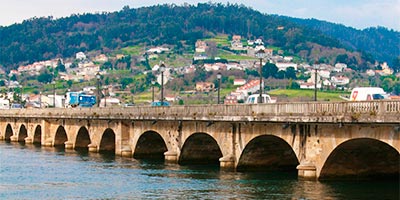
Our first stop on the tour of Pontedeume is the Stone Bridge over the Eume River, which gave the town its name. This is not the original bridge built during the Andrades’ time; this one was built between 1863 and 1870 and then refurbished between 1884 and 1888, but it still maintains the essence of the original. The sole remnants of the old Gothic bridge with 68 arches, commissioned by Fernán Pérez de Andrade, are the bear and wild boar that flank the N-651 highway, which once stood between the second and third arches of the bridge.
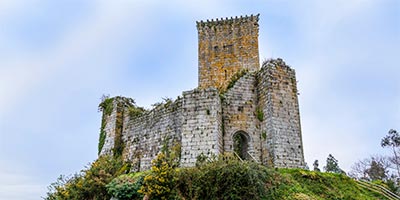
The old Andrade mansion was destroyed in 1935 at the time of the Spanish Republic, despite having been declared a Historical-Artistic Monument, but the Andrade Turrethas been preserved. This 18-meter-tall keep, with a square-shaped floor plan topped with battlements and machicolations, rises majestically over the port. Today it houses the Tourism Office and an interpretation center dedicated to the Andrades.
The town’sdefensive wall, which had nine towers and five gates, once extended along the seashore and surrounded the Andrades’ home. Today the base of the old wall is housed in the atrium of the Church of Santiago, located in the historical quarternext to what was once the Postigo Gateway. The only remnant of the original church, completed at the time of Fernando de Andrade (during the first third of the 16th century), is the Main Chapel; the rest is a product of 18th-century restoration commissioned by Archbishop Bartolomé Rajoy y Losada. The church, covered with a star-dotted cupola, houses an excellent 14th-century statue of a seated Saint James in polychrome granite and a Renaissance altarpiece from 1530, which was expanded and covered in gold in 1564 by the descendants of Fernando de Andrade. The façade of the church, with its towers, is a notable example of the Galician Baroque style.
The façade of thecountry home of Archbishop Rajoy (18th century) features elements typical of the Compostela School as well as other more classical, French-influenced components. It consists of a ground floor with a portico supported by thick pillars, two floors with balconies, and is emblazoned with the archbishop’s coat of arms. Next to the archbishop’s house is the Plaza del Pan, where a wheat storehouse once stood. In 1984, the plaza was restored by the artist José Dias Fuentes, who also did the bronze statue of a woman kneading bread that stands in the plaza.
Another of the many things to do in Pontedeume is the Concello Building (town hall), an old symbol of the Andrades’ power. The building was damaged by a 1607 fire and was rebuilt two years later. To have a drink and take in the local ambiance, head to the Rua Real, an area with terraces where businesses have set up stands.
Outside the historical quarter, about two kilometers from Pontedeume, you can find San Miguel de Breamo Chapel (12th century), built by the Knights Templar in 1187. Its floor plan is in the shape of a Latin cross and it has three apses. Amidst an otherwise austere architectural style, the church has a rose window framed by an 11-point star.
Pontedeume is also a place for relaxation, as it has countless beaches and coves as well as campsites where you can lose yourself wandering around and exploring. Canoeing, riding on horseback, biking, or walking…these are all good ways to explore Pontedeume and the surrounding area.
Essentials
Practical Information
IMPORTANT INFORMATION
43° 24’ 9’’ N, 8° 9’ 10’’ W
Coruña 41 km, Santiago de Compostela 82 km, Pontevedra 141 km, Madrid 584 kmParking
Easily accessible in the town and surrounding areaAltitude
54 m
8,213 (2013)