
The Lebaniego Way

Did you know that in our country you will find one of the greatest pieces of the Cross of Christ? This fact is not known by many Spaniards, but it is indeed, true. The Lignum Crucis (wood of the cross) can be found at the Monastery of Santo Toribio de Liébana in Cantabria. The relic arrived in the hands of Toribio de Astorga, in the Middle Ages, from Jerusalem. Because of this, on September 23, 1512, July II granted to the city a papal bull which stated that each year in which the 16th of April, the Day of Santo Toribio, fell on a Sunday, they would celebrate a jubilee year, making the monastery a pilgrimage center. This is how the Camino Lebaniego was born.

However, success of this path is not only due to this factor. First, it is a striking destination because it houses part of the cross; Second, because the monastery houses the remains of the Saint, which is said to have healing powers. Third, because of its link to two of the routes leading to Santiago de Compostela: The Camino of the Norte and Camino de Francés, making Cantabria the only place in the world with two pilgrimage paths.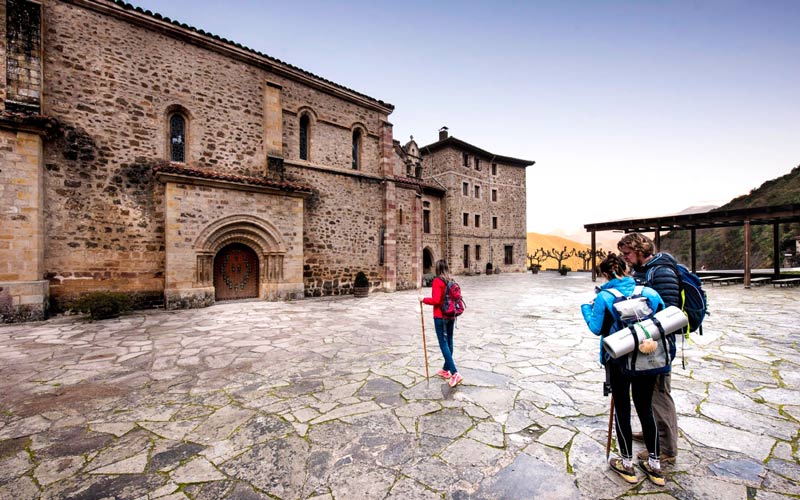
The Lebaniego Road has its own accreditation, the Lebaniega. It is collected in the Parish of Christ, in Santander, and can also be requested by email. As in the Camino de Santiago, the notebook must have a stamp of each of the stages; At least three of them have to be completed. Accreditation can be done both in roadside churches, in shelters or in tourist offices.
The route to the monastery consists of three stages:
1. San Vicente de la Barquera- Cades (28,5km)
This part of the Camino begins in the Gothic-style church of Our Lady of the Angels. The crucial stretch of this voyage is through Muñorrodero. In this locality there is the separation of the pilgrims who go to the Camino de Santiago and those who continue the pilgrimage to the monastery of Santo Toribio.At this stage of the Camino Lebaniego, you will be able to visit many medieval buildings such as the remains of the Hospital de la Concepción (15th-16th century), the Convent of San Luis (15th century) and the medieval towers of Estrada and Cabanzón.
2. Cades- Cabañes (30,53km)
3. Cabañes-Santo Toribio (13,7km)
The last stage is the shortest. As we have seen in the previous stages, at this stage of the Camino Lebaniego we can also find architectural treasures. One of them is the Tower of the Infanta, in Potes, from the 15th century. It is located in the old part of the city, considered a Historical-Artistic Collection, and is currently used as a town hall.Finally, and arriving at the end of the road, is the Monastery of Santo Toribio, the goal of the pilgrimage. The complex, built between the 13th and 18th centuries, contains Romanesque, Gothic and baroque style features. This is where the remains of the Saint and those of the Lignum Crucis are found. One of the most relevant parts is the Door of Foregiveness, which opens every jubilee year. The portico, of archaic Romanesque style, has the images of the 15 saints of Lebaniegos in bronze along with a reproduction of the part of the Cross of Christ.Text: Fátima González-Besada