
Laredo—Battle of the Flowers
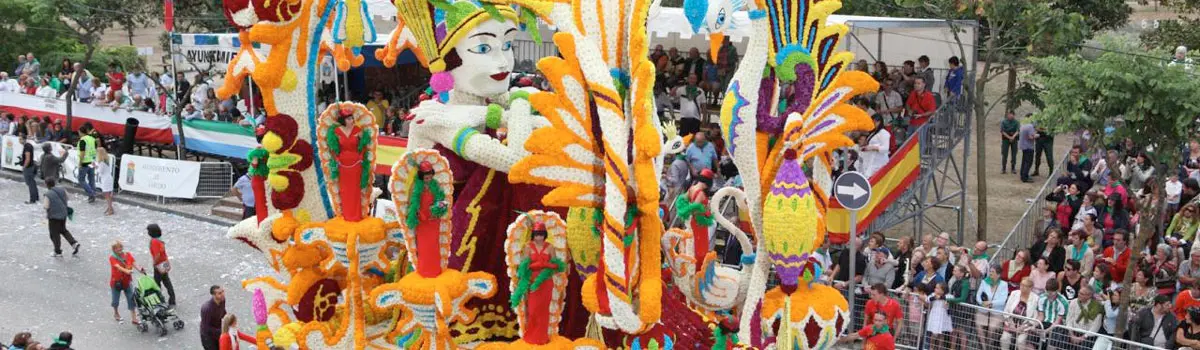
During the Battle of the Flowers, decorated floats parade around the streets of Laredo.
In the town of Laredo, located on the east coast of the autonomous community of Cantabria, the traditional Battle of the Flowers takes place on the last Friday in August. The event came about in the early 20th century, and in 1965 it was declared a Festival of Touristic Interest (Fiesta de Interés Turístico) by the Spanish government.
Unlike many other major celebrations in the north of Spain, the Battle of the Flowers originated relatively recently. In the summer of 1908, representatives of the governments of the three port towns on the bay (Laredo, Colindres, and Santoña) were received by King Alfonso XII in Santoña. The representatives shared their concern that big trawling ships were hurting the livelihood of smaller fishermen. A group of rowboats belonging to the fishermen’s guild were decorated with flowers, garlands, and Spanish flags and participated in a regatta in the bay. The event was widely attended thanks to the king’s presence, and the famous boat La Argentina emerged victorious.
Around that time, the baños de ola on the beaches of Spain’s northern coast had become trendy among the wealthy families of the aristocracy and bourgeoisie who vacationed there in the summer. In 1909, this prompted the local government to make the parade of the previous year a tradition, but they decided to move it from the water to dry land. Carriages decorated with flowers—the precursors of the present-day floats—replaced the rowboats and paraded around the streets of the city. A competition was held in which a panel of judges chose the winning floats.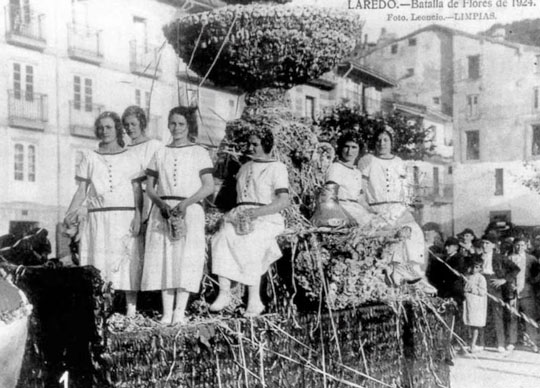
Over time, the festival regained its essence as a hedonistic folk celebration. The participation of the common people also became even more significant; members of the upper class no longer paraded around on the floats, which were now designed by local artisans.
The materials originally used as a base for the flowers, such as sackcloth, were replaced by plaster. Today, synthetic cork is used, which allows for the creation of even larger displays as it is very light. Each float represents a theme or allegory and the designers, known as “carrocistas,” work on them for months leading up to the parade. There are regulations specifying measurements for the floats, and they must be decorated exclusively with real flowers which have to cover at least 75% of the surface area; some floats use up to 100,000 flowers. Groups of children accompany the floats dressed in outfits related to their respective theme.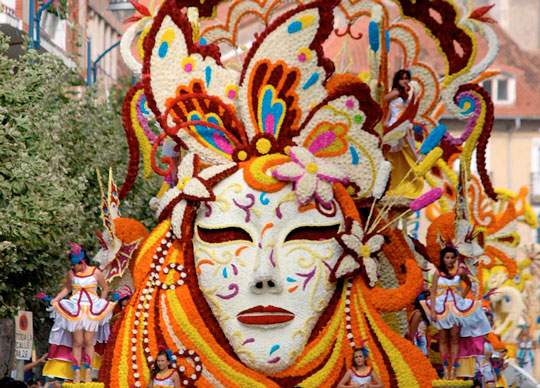
A spectacular moment takes place at midnight, when fireworks illuminate La Salvé Beach. This gorgeous seashell-shaped beach is one of the largest beaches on the Cantabrian Sea at 4,250 meters long. The celebration continues into the morning with musical performances in Tres Pescadores Park.