
The history of the Spanish flag

This year celebrates the 180th anniversary of when the Spanish flag was first recognized by the Royal Decree of 1843, signed by Isabella II. This regulation turned the two-colored flag of Spain with a shield in the center into what we know today as the Spanish flag. Although is has been with us for 180 years, many do not know its history. In fact, according to a survey by the 1785 Project, 55% of Spaniards do not know the origin of the flag of Spain.

The history of the Spanish flag is tied to the rule of Charles III. The king raised the need to create a national sign that would stand out well in the seas. Until then, the Spanish flag was white, and on it was the Bourbon coat of arms.
The problem was that the other kingdoms of the same era, like Parma, Naples, France, Tuscany, or Sicily, in addition to Great Britain, also used a white background. This made it almost impossible to distinguish allied ships from the enemy at a distance.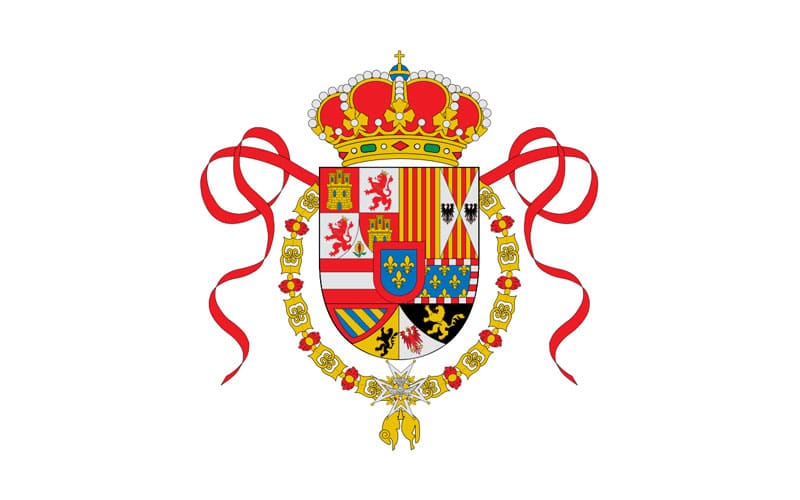
King Charles III chose two designs; one for the navy and the other for the merchant navy. In both he chose red and yellow because they were two colors that were perfectly distinguishable at sea. The first one was based on two red stripes and a yellow one, as we know today the Spanish flag. The second was based on three yellow and two red stripes.
Despite the fact that it had become tremendously popular, at that time each faction of the army had its own. Isabella II decided to unify them and, from that moment, the red and yellow colours remained unchanged until our days, except for the period of the Second Republic (1931-1936).
During this stage the red of the lower strip was changed for the purple one in homage to the Comuneros of Castile who fought against Charles I. Although much has been written about this, it is not proven that purple was the color of the Comuneros, as it was the crimson.
Evolution of the history of the Spanish flag

Later, in the Second Republic (1931-1939), apart from the colour purple, the coat of arms was completely modified. The kingdoms of Aragon, Granada and Navarre were added, and the crown was replaced by a castle at the top of the coat of arms. The two columns of Hercules were also included with the motto "Plus Ultra", which means "Beyond".
But then the Civil War started and the rebellious side (and finally victorious), retook the red and yellow combination and modified the coat of arms again. The so-called Francoist flag eliminated the castle that crowned it and replaced it again with a crown. The eagle of San Juan was also included, in homage to the Catholic Monarchs.
Author: Paloma Díaz Espiñeira