Labastida - Bastida
The Palace of Wine
Labastida was a medieval fortress that became a prosperous village for wine producers. It's a place where you can relax and fully enjoy the culture of wine.Plan your visit to Labastida
In addition to having a historic centre with palaces and ancestral homes that denote the nobility and economic power of its inhabitants, Labastida is also home to wine cellars and wine ‘caves.’ And if the sightseeing tour can take a few hours, the enjoyment of the wine culture and shopping can last much longer. Nearby is the town of Haro in La Rioja, where you can learn more in their wine interpretation centre. In Labastida there is a wide range of active tourism activities, the most popular being hiking in the nature park, which includes the Cantabria mountains. To find out about the local cuisine and to book a place to stay in the region, we suggest looking at our pages for where to sleep and eat in Labastida.Do you want to visit this place?History of Labastida
The origin of Labastida's name comes from the word "bastion." Its root is not documented, but it is associated with the missing castle that would be located on Mount Toloño. In the area of the town there are four sets of burials carved into the rock, dating from the early Middle Ages, which are the oldest surviving evidence. During the history of Labastida, the city was apparently founded by the Navarrese monarch Sancho VII el Fuerte at the end of the 12th century. Like the rest of Álava, in 1200 it passed into Castilian hands during the reign of Alfonso VIII. In 1242, Ferdinand III granted it the status of a villa, granting it the privilege of Treviño. In 1379 King Henry II gave it to the knight Diego Gómez Sarmiento, whose family held power until the 15th century, when Labastida returned to the hands of the Crown.
What to see in Labastida
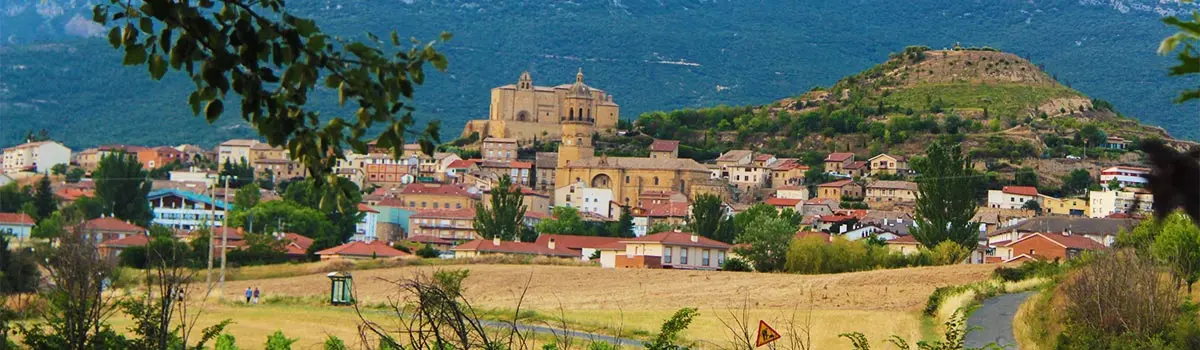
Labastida, like Elciego and other places in La Rioja Alavesa, is an essential stop for wine lovers. The town centre is lasting testament to the glory of the modern town, a direct result of its successful economic growth in the past. These times are evidenced by a wealth of historical and artistic heritage that has earned it the status of a Monumental Complex.

At the top of the town, on its northern slope, is the fortified hill of La Mota, which gave rise to the town known as "El Bastión" (The Bastion), where the Hermitage of Santo Cristo is located. This twelfth century medieval building has Gothic additions, like its fabulous late Romanesque façade.
The most emblematic building in Labastida is the Parish Church of Nuestra Señora de la Asunción, whose construction, in the Baroque style, occupied a large part of the sixteenth and seventeenth centuries. With a single nave plan divided into five sections, the monumentality of the façade is striking. It is also worth observing its 18th century organ with horizontal pipes.
On calle Mayor (Main Street) there are numerous manor houses and noble palaces, some of which still bear the coats of arms of their families on their façades. During the 17th and 18th centuries, Labastida was the most emblazoned town in the whole of Rioja Alavesa. The Calle Mayor leads to the Mayor Plaza or Plaza de la Paz, where the Town Hall stands, an eighteenth century porticoed building with a beautiful Baroque façade. Next to it is the Palace of Salazar and Quintano (eighteenth century), which was restored in the 1980s and now houses the Casa de la Cultura (House of Culture).

Its streets are home to a large number of wineries that make it one of the largest wine producers in the region. Some of them have the special charm of places where the artisan processes of the past coexist with modern and innovative methods. These wineries can be visited by appointment. One of them, Agrícola Labastida, contains a network of underground caves that have been used for production since the thirteenth century. Other wineries in Labastida are González Teso, Mitarte, Señorío de Arana, Finca de la Rica, Nuestra Señora de Remelluri, Ibaiondo and Marqués de Carrión.
Must see


Basic Facts
PRACTICAL DATA
42° 35′ 0″ N, 2° 47′ 0″ W
Vitoria-Gasteiz 40 km, Bilbao 92 km, Madrid 343 km
At the end of Mayor Street
550 m
1476 (2013)